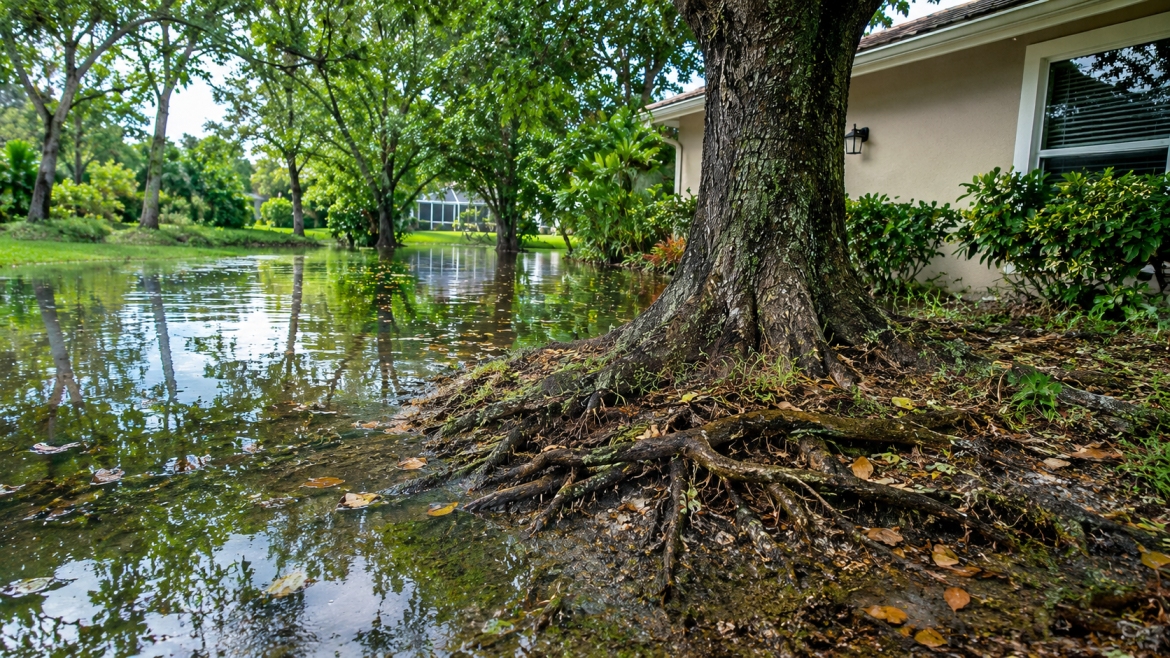
Every fall, South Florida residents watch saltwater creep into streets, parking lots, and backyards that sit nowhere near the beach. The water rises, lingers for a few hours, and then drains away. To most people, the event is over when the puddles disappear.
For the trees and plants on that property, it may only be beginning.
The most serious effects of a king tide happen below the soil surface, out of sight, where roots live. Saturated soil, a sudden loss of oxygen, and a load of salt left behind after the water recedes can set off a chain of damage that does not show up in the canopy for weeks or even months. By the time leaves brown, fronds collapse, or limbs die back, the injury underground is often well established.
Understanding what is happening in the root zone is the first step toward recognizing when a tree is in trouble.
What Is a King Tide?
A king tide is the informal name for the highest predicted high tides of the year. They occur when the moon is closest to the Earth and aligns with the sun, combining their gravitational pull. In South Florida, the most pronounced king tides typically arrive in the fall, when seasonal water levels in the Atlantic are already elevated.
What makes king tides especially damaging here is the ground itself. Much of South Florida sits on porous limestone. Seawater does not just wash over seawalls; it pushes up through the bedrock, bubbles out of storm drains, and raises the water table from below. That means a property can flood with brackish or salt water even when no wave ever reaches it.
And unlike a storm surge, king tides return. They repeat over several days in each cycle and across several months each season. A tree may be exposed not once, but again and again.
When Roots Go Under Water
Most people picture tree roots plunging deep into the earth. In reality, the majority of a tree’s absorbing roots live in the top 12 to 18 inches of soil, and they spread well beyond the edge of the canopy. In South Florida’s shallow, sandy soils over limestone, roots are often even closer to the surface.
That shallow root zone is exactly where king tide water collects. When the water table rises, the open spaces between soil particles, called pore spaces, fill completely with water. Healthy soil is roughly half solid material and half pore space, and in well-drained soil much of that pore space holds air. During a king tide, the air is pushed out.
The fine feeder roots that take up water and nutrients are delicate, short-lived structures, often thinner than a strand of thread. They are the first casualties when conditions turn hostile, and they are also the part of the tree no one ever sees.
Anaerobic Soil: Roots That Cannot Breathe
Roots need oxygen. Unlike leaves, they cannot make their own. They rely on air moving through the soil to fuel respiration, the process that powers water uptake, nutrient absorption, and new root growth.
Oxygen moves through water roughly 10,000 times more slowly than it moves through air. Once soil is saturated, the small amount of oxygen dissolved in the water is used up quickly by roots and soil microbes. Within hours to a few days, the root zone can become anaerobic, meaning it has little or no available oxygen.
When that happens, a series of problems follows:
- Root function shuts down. Without oxygen, roots cannot pull in water efficiently. Ironically, a tree standing in water can begin to show drought symptoms, because its roots can no longer move that water up into the canopy.
- Fine roots die. Feeder roots begin to die back, sometimes in large numbers. Each lost root reduces the tree’s ability to recover once the water drains.
- Soil chemistry changes. Anaerobic microbes take over and produce byproducts such as hydrogen sulfide, the source of that rotten-egg smell in waterlogged ground. Iron and manganese shift into forms that can become toxic to roots, and nitrogen is lost from the soil.
- Decay organisms gain a foothold. Stressed and dying roots are an open door for root-rot fungi and other pathogens, which favor wet, low-oxygen conditions.
A single short flooding event may be survivable for a vigorous tree. The danger in king tide season is repetition. Roots that are damaged in one cycle may not have time to regrow before the next one arrives.
The Salt Left Behind
King tide water is not rainwater. It is seawater or brackish water, and when it drains or evaporates, much of its salt stays in the soil. This is where the damage can outlast the flood itself.
Salt harms trees in three main ways.
Physiological drought. Water naturally moves from areas of low salt concentration to areas of high concentration. When the soil around the roots becomes saltier than the fluid inside the roots, the tree has to work much harder to draw water in. In severe cases, water can be pulled back out of the roots. The tree is surrounded by moisture and still cannot drink.
Direct toxicity. Seawater is loaded with sodium and chloride. Roots absorb these ions and send them upward, where they build up in leaf tissue. Chloride in particular tends to concentrate at leaf tips and margins, causing the scorched, burned edges often seen after a saltwater event. Over time, these ions disrupt photosynthesis and other basic functions inside the leaf.
Damage to soil structure and fertility. Sodium displaces essential nutrients such as calcium, magnesium, and potassium from the soil particles that hold them. In soils with clay or organic content, excess sodium can break down soil structure, reducing drainage and aeration even after the water is gone. The result is a root zone that is less fertile and more prone to staying wet the next time.
Flooding and salt together
The combination is worse than either problem alone. Healthy roots have some ability to screen out sodium and chloride. Oxygen-starved, damaged roots lose that ability. So the same king tide that suffocates the roots also leaves them less able to defend against the salt that follows.
Species tolerance matters. Native coastal trees such as sea grape, buttonwood, and cabbage palm evolved with salt exposure. Many common landscape trees and ornamental plants did not, and a property can lose them even when neighboring native plants appear unaffected.
Why the Damage Shows Up Late
One of the most misleading things about king tide injury is the delay. A tree may look perfectly normal the week after the water recedes. The canopy is running on stored reserves, and the leaves that were already formed may hold on for a while.
Symptoms commonly appear weeks to months later and may include:
- Browning or scorching along leaf edges and tips
- Yellowing, wilting, or early leaf drop
- Browned or collapsing fronds on palms
- Thin, sparse canopies and twig or branch dieback
- Stunted new growth the following season
- Mushrooms, conks, or soft decay near the root flare or trunk base
These symptoms are easily mistaken for drought, nutrient deficiency, insects, or ordinary seasonal decline. That confusion matters. When the true cause is not identified, the wrong response follows, and the tree continues to decline.
There is also a safety dimension. Roots weakened by oxygen starvation, salt, and decay do more than feed the tree. They anchor it. A tree that has lost a significant portion of its root system can appear upright and leafy while its stability is compromised. In a region that also faces tropical storms and hurricane-force winds, that hidden loss of anchorage can turn a stressed tree into a hazard to homes, vehicles, and people.
Don’t Wait for the Canopy to Tell You
King tides are not going away. As sea levels continue to rise, South Florida properties that once stayed dry are seeing saltwater reach their landscapes more often and for longer periods. For trees, every one of those events adds to the stress underground.
The problems described here are complex. Saturated soil, oxygen loss, and salt work together, and their effects vary with species, soil type, elevation, drainage, and how often a site floods. Telling the difference between salt injury, flood injury, disease, and normal decline takes trained eyes and an on-site evaluation.
Why timing matters
King tide damage does not wait. Roots can begin to suffocate within hours of saturation, and salt starts moving into root tissue as soon as it reaches the root zone. With each tide cycle that follows, the injury compounds. What starts as stress on a few feeder roots can progress to widespread root loss, canopy decline, and the death of trees, palms, shrubs, and other landscape material in a matter of weeks.
That is why a prompt evaluation by a consulting arborist is so important. An early assessment captures conditions while the evidence is still present: standing water, soil saturation, salt deposits, and the first subtle signs of stress. It establishes which trees and plants were affected, how severely, and which are at greatest risk. Waiting until the canopy shows obvious symptoms often means the most critical window has already passed, and options narrow as decline advances.
Timely documentation matters for another reason. If an insurance claim, HOA responsibility, or property dispute may follow, a professional record made soon after the event carries far more weight than one made months later, when the cause is harder to establish.
If your trees were exposed to king tide flooding, or you are seeing unexplained browning, dieback, or decline, do not wait for the problem to become visible from the street. Have them professionally assessed as soon as possible, before a weakened tree becomes a failed one.
Arborist Consulting Solutions provides independent, on-site tree evaluations for property owners, HOAs, municipalities, insurance professionals, and attorneys throughout Palm Beach, Broward, and Miami-Dade counties. Ron Lamneck is an ISA Certified Arborist with TRAQ credentials and has been working in arboriculture since 1987.
If you have a concern about your trees after a king tide, contact us to schedule an evaluation.